Thursday, June 4, 2020

76 Card Sabacc Rules


I've avoided "Traditional Sabacc" or "76 Card Sabacc" for a while.

Mainly for two reasons:

1. The rules seemed overly complicated and based mostly on fantasy.

and

2. I didn't have a deck.

But now I have a 76 card Sabacc deck and actually took the time to learn how to play. Needless to say I was wrong to poo-poo on this version. And I actually really like the variety it offers.

So today I'm going to cover the "rules", explain the differences between versions, offer modifications and overall provide more insight on how to actually play. But not just the same 6 paragraphs you find literally everywhere. There'll be pictures, better explanations and hopefully a better appreciation for the game. And more than likely sarcasm.

Overview


Traditional Sabacc, or 76 Card Sabacc is *mostly* the original version of the game. It's funny that this "variant" would become the one that everybody compares everything else to. As it never received any kind of meaningful release. I believe there was a set of rules released in the 80s-90s in a Star Wars RPG called "Crisis on Cloud City". In fact, let's say you're an overly pretentious Sabacc purist. You would probably be bragging about how you remember playing the 84 card version included with the game.

Even as write this, I've already decided I'm gonna buy a copy
People played this, literally dozens


(84 cards? Might as well round that up to 100)

Anyway, the game is a mix of poker/blackjack/baccarat/Shan Koe Mee/and a slot machine.

The Game


This version of Sabacc is played with a 76 card deck. A large percentage of them are positive, with a smaller percentage being negative. The goal is to get to 23 or -23 from your paltry two starting cards and drawing from 1 pile. Best when played with 3-6 players and betting. Extra points if you're drinking brandy.


The Setup and Gameplay


Eventually you should start playing. So lets' go over what you need.

(Please note that these rules may not be what you find elsewhere. But I have taken concepts from almost every available resource online, and actual card games to create a set of rules that address certain flaws.)

so basically......


  • One 76 Card Sabacc deck (preferably from Lucky Sylop)
  • Two or more people. But less than 8.
  • One pair of d6 dice.
  • Probably a table.
  • Chips if you so choose.


  1. Choose a player to be the dealer. Don't get too excited, you're just handing out cards.
    -If you want to go by "Skip-Bo" rules, the youngest player starts as dealer.


    Steven Bridges everybody!


  2. The dealer (starting from their left) will deal out two total cards, one at a time to each player.


  3. After all the cards are dealt, place the remainder of the deck in the middle of all the players.
    (or in front of the dealer if you want to be that kind of person)
  4. The Player to the left of the dealer goes first.

  5. During what's called the "Action Phase", you have 4 options:

    -Gain: take the top card from the Draw Pile and add it to your hand


    -Swap: place a card from your hand face up next to the Draw Pile (discard pile) and take the top card from the Draw Pile to add to your hand. You do not have the option to choose another if you didn't get what you want.

    -(I didn't think to number them, so follow the pictures from right to left, top to bottom)


  6. -Stand: keep the cards in your hand and do nothing.
    I think I'll stay

    -Fold: if you feel you cannot win with the cards dealt, place your cards in the Discard Pile next to the Draw Pile.
    (I do NOT suggest a penalty for doing this)


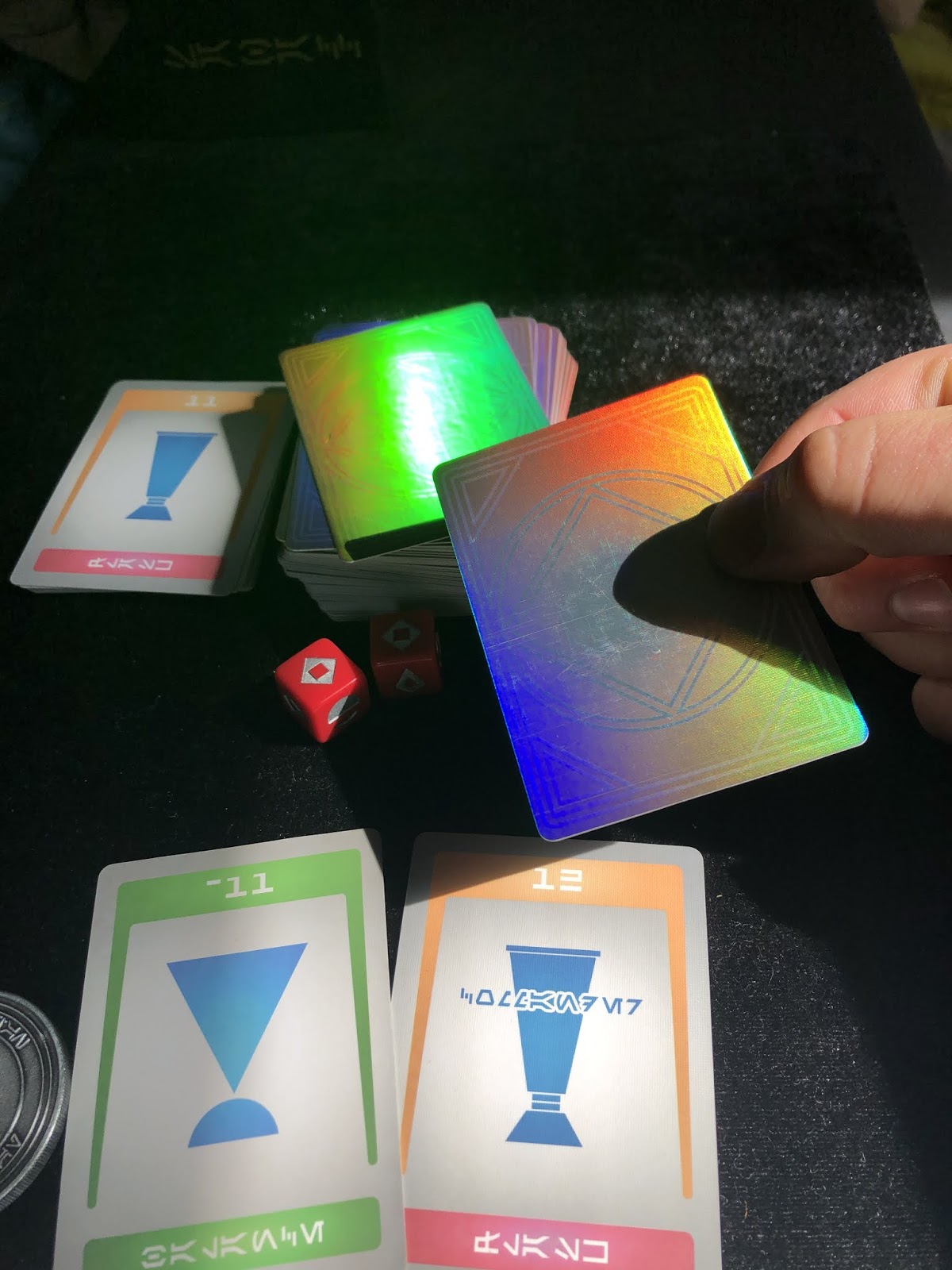
  7. After all players have completed their hand actions, the dealer will then roll the dice.

    Just in case you forgot how to roll

    -If doubles are rolled, all players discard their hands and receive the same amount of new cards from the Draw Pile.


    -If no doubles, all players keep their hands.

  8. (This would be where betting starts)---another time
  9. Repeat the Player Action Phase 2 more times for a total of 3 rounds.
  10. The player to the left of the dealer will now be the dealer, so on and so forth each round.
  11. After the 3rd round of play, the game can still continue. But any player (starting to the left of the dealer) can "Call" the hand.
    -This means that player actions cease and only standing (calling),raising, folding, and other assorted betting can take place. (My favorite is to call the hand and raise)
  12. After the last player has made their decision, the dice are rolled one last time.
  13. All players then show their hands starting with the player to the left of the dealer.

Judging Hands


The objective of the game is to have a hand closest to 23 or -23 at the time of the showdown. This is pretty straightforward, but there are some established hands to take into account.

Idiot's Array: probably the most famous hand in all of Sabacc-dom. The Idiot's Array consists of  a 2, 3 and a zero card. (2,3,0). This is the best hand in the game, and beats a Pure Sabacc.
-
0, 2, 3
Pure Sabacc: any hand totaling exactly 23 or -23
(Note-- under most rule sets 23 beats -23. But given the uneven distribution of positive and negative numbers. It's WAY less likely you'll get -23. So if you're looking for a good modification, place -23 over 23.)
-

All other hands: Any hand lower than 23 (or "higher" in the case of -23), is just plan ol' non-Pure Sabacc. All these hands are judged on how close it gets to 23 or -23.


Examples:
22 beats 21
-10 beats 9
20 beats -20
etc etc

Bombing Out: if at the end of the showdown (after all the hands are called) your hand totals above 23 /-23 or exactly zero, you are "bombed out" of the game. This means you lose the hand, and in most cases have to pay some kind of penalty into the pot (or Sabacc pot).

Other Questions and Considerations


What if two or more players bomb out?
If two players bomb out, they are both out of the game assuming there are other active players. If two or more players bomb out and they are the only ones left, then the player who is closest to 23 would win. There aren't necessarily super clear rules on this. But I would suggest the winner who still bombed out would collect the pot, but still pay a penalty into the Sabacc Pot.

What happens in the event of a tie?
In most rule sets the winner of a tie is determined by a "Sudden Demise" round or a roll of the dice. I'm firmly against this as there are enough ways to determine a winner without resorting to just blind luck.
Modification: assuming both hands have the same total, the player who has the most cards wins.

What about the "Interference Field" to freeze cards?
If you want to add this in, all you do is include the action during the "Action Phase". So you can Gain, Swap, Stand, Fold, and additionally "Freeze" a card (but still only get to pick one).
I neglected this for several reasons, but mostly it's just unnecessary. After playing hundreds of hands and seeing how the field works. All that happens is that a player will freeze their zero. You can also freeze a really good hand, but if you do that you'll either encourage people to beat it or have everyone fold.

What about betting?
Like I said earlier, I'm not going to include the rules for betting in this post. But I did include *when* you'd add it in, which would be after the Action Phase. 

And the Ante?
Same thing. But if you were going to do it, you'd place the antes in the Main Pot before the cards are dealt.

Do the suits mean anything?
No.

How does the Sabacc Pot work?
While this would still fall under the rules of betting, which I'm not going to cover in full yet. In each game you have your "Main Pot", where all antes and bets are placed. Then you have your "Sabacc Pot" which is a secondary pot meant to include player penalties for bombing out, small percentages of the Main Pot, and other assorted things based on what kind of flavor you want your game to have.

 For example, lets say you have 4 players in a game. Each player contributes 2 chips into the main pot. Then take 2-4 chips and place them in the Sabacc Pot.

But the Sabacc Pot is ONLY won when a player has either a Pure Sabacc or Idiot's Array. Otherwise it continues to grow each round. It becomes very important later on.

I also DO NOT recommend that you penalize folding. It encourages players to see ANY hand into the showdown and overall bad play.

Is there a Discard Pile?
Yes, but you can't draw from it. However it is presented face up so you can get an idea of what's already been in play.

What if I get 2 zero cards?
As this is a unique hand that has a very low chance of happening, it deserves something. I would also suggest using it like in Corellian Spike. Where if your Sabacc hand totals zero, and you have a Sylop. It ends up being a pretty darn good hand.

How many cards can I have?
At least 2, and then there isn't a "limit" really. But it usually ends up being up to 6-8 if it's a wild and crazy game.


The Cards and Such


 I don't have much to write here other than, "gee here are the cards". Not much emphasis is put on the suits, special numbers or anything else like that. The only limited exception would be the zero cards/Idiots. But let this also be an explanation on the translations and what they're named.


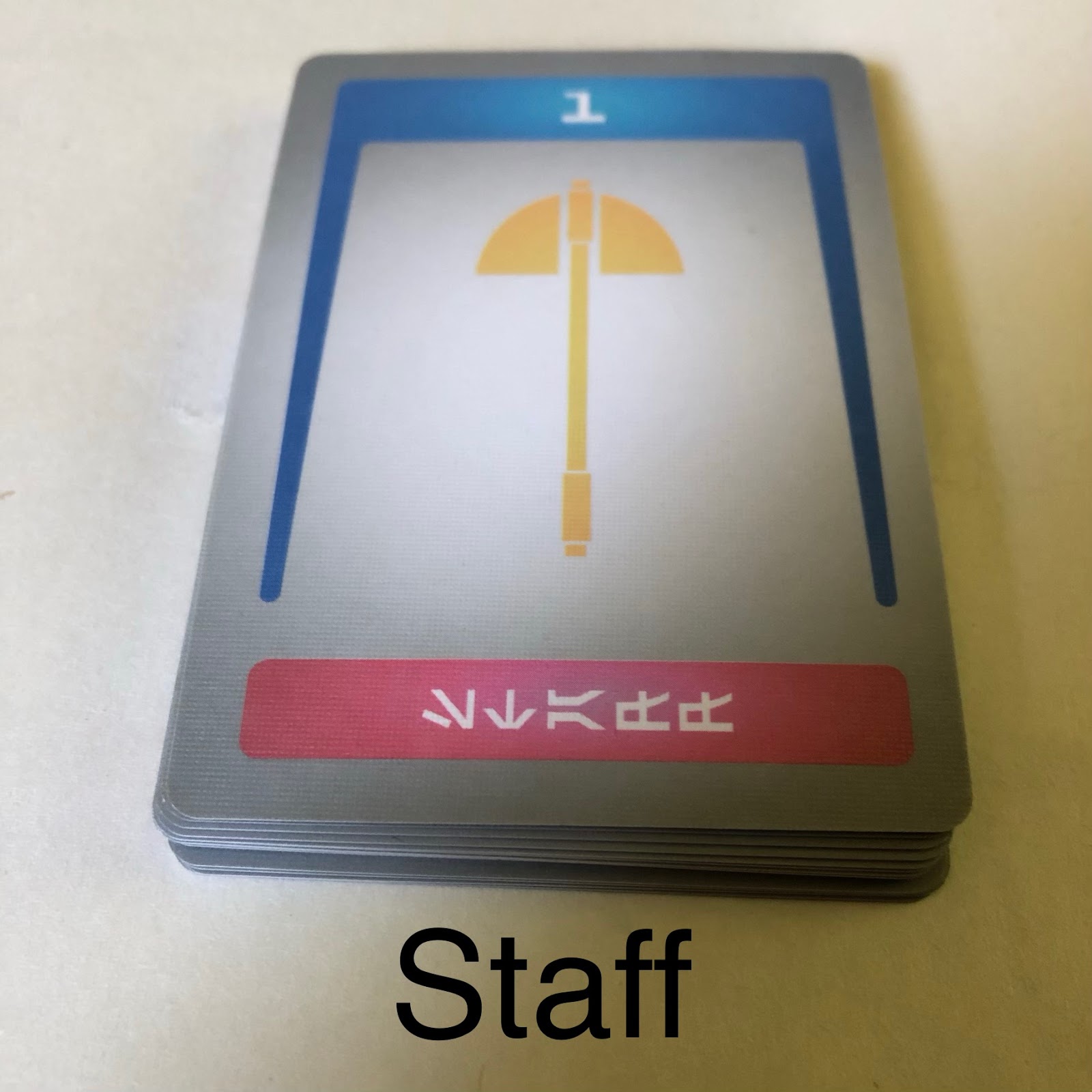
First you got the Four Suits: Flask, Staff (Stave), Saber, Coin.

Of course you'd say "1 of Flasks" etc

also called "Staves"


My personal favorite

Which is mightier, the Coin or the Saber? (neither)

These are all numbered 1-15, with 11-15 having sub-suit names that serve doubly no purpose.

They are:
Commander......12
Mistress......13
Master ...14
Ace .......15

These are the same for each suit 


So you got your four suits, for a total of 60 cards. What about the other 16?


(and now in no particular order)


These are ALL the negative cards in the game (minus the Idiot). So as you can see, the deck is mostly positive. So achieving a -23 becomes a bit trickier.

Like I said, none of the names are necessarily important. But at least now you know. Some versions of this game will the same basic cards, just different-ish names. Or you'll find the values are sequential from a certain point. Blah blah blah. This works. They were modeled directly on the deck that was given out at Celebration Anaheim.


The end

So there you have it. A thorough explanation of "Traditional Sabacc". The rules presented in this blog are one of many you will find online. But I believe these to be pretty close to the original intent of the game, as well as fixing some major holes (still some left). This version is fun to play, easy to teach, and retains a lot of the complexity some like in their space fantasy cards games.

Of course you can add whatever you like if you think it's fun. The best way to play Sabacc is the way you enjoy. Nor is any of this written in stone. I've oftentimes changed my mind on certain rules or game play features because someone suggested a better way.

The main thing I'm noticing about this version of Sabacc as opposed to Corellian Spike, is the distinct lack of a hand hierarchy. Which does make judging hands a bit like, "oh well, tie breaker". But there is a lot of potential here for improvements that wouldn't over complicate things.

Anyway, look for my next blog where I discuss the similarities of 76 Card and Corellian Spike!


Stay cool.

Tuesday, February 25, 2020

Sabacc: The GAIN and SWAP


The Gain and Swap


If I were to make a list of the most commonly misunderstood aspects of the game, these two actions would be at the top.
To be fair, the instructions don't really help clarify things for people just getting started. So I'm going to further explain these actions, how they work, what not to do, and some light strategy.


Here is the starting hand I'll be referencing a lot during this. Not the greatest hand.


THE SWAP


In this example, I started out with a -4 and a -2. Try not to pay too much attention to the fact that I shouldn't have made this move in the first place. It's just to show how these work.

For the SWAP, I cannot just take the top card from the Discard Pile and add it to my hand. I first have to discard one of my cards and take the top card from the Discard Pile. 

There is only one way to do a SWAP.

Even though you cannot just take the top the card. This is one of the few times in Sabacc where you get to see a card before you can take it. But beware, it changes a lot. Especially if there are more than 3 players.


 THE GAIN

Unlike the SWAP, there are two ways to go about the GAIN. 

You can either take a card from the Draw Pile and just add it to your hand.

Or

You can discard a card first, and then take a card from the Draw Pile.

Either way, you are drawing a card blind from the Draw Pile.


In the above example I am doing a Gain without a discard. So I just add the top card from the Draw pile to my hand. That's about it.


Where it gets complicated is the Discard/Gain. Here you first  Discard a card from your hand into the Discard Pile, and then take the top card from the Draw Pile.

The other actions I didn't cover would be Standing, and Folding. But they are also important.

And to answer the question I always get about the Discard/Gain. Is it still Gaining a card if you're discarding?

Yes. Think of it more as the Game is Gaining a card. Not just your hand.

Strategy


If you choose to ignore these rules and play a different way, you may be short changing yourself. These actions work together to provide the overall strategy of the game. And pretty much all the fun.

  • Use the SWAP if something will get you -2 to +2 (including zero).
  • Gain a card if all other Actions put your hand over its current total or above +2/-2.
  • Discard the larger card before Gaining (usually) if you know nothing can bring your card to zero by not discarding. For example, if you have a +10 and +9 as a starting hand. There are no cards that will bring it to zero. 
  • In this example, I might just Gain a card without discarding. Best case scenario I get a positive card of any value. And if not,  at least I have a card to now Swap with something.
  • Pay attention to the cards played/discarded. Since there are only 3 of each cards, if you see the card you need buried in the discard pile. It might be best to not bank on getting what you need.


So there you have it, a brief explanation of the Gain and Swap action. Plus a little strategy. 

Feel free to ask me any questions. Have fun everybody!


Wednesday, January 22, 2020

Sabacc Variations and Rule Modifications


In Legends stories there are "multiple variations" of Sabacc all over the Galaxy. But here on Earth where only so much space fantasy is possible, we have one or two versions that have consistent rules. Even Cast Members at the Disney Parks claim to be teaching some version or variation of Sabacc. I'm not saying these are bad, I'm not saying they're good.

Lando is apparently an expert on the "80 variants" of Sabacc throughout the galaxy.


But at the end of the day, wouldn't you like to play a semi balanced game?

For any kind of "modification" to work, it has to serve a purpose. Does it improve the game? Does it address some kind of issue? Does the rule affect the balance of the game? And so on and so forth.

So below are several modifications and/or variations that I've developed.

Disclaimer: true to my own words these modifications are entirely optional. And I'm always thinking about whether or not they are necessary.


One Pair Sabacc vs One Pair Sabacc?


The winning hand pages of the rule book gives two examples of SABACC (or one pair SABACC). One of them is plain wrong (+5,+5) and (+3,+3,-6) isn't ONE PAIR. The hand "YEE-HAA" which is a zero card and ONE PAIR probably gives the best example of what ONE PAIR looks like.


Probably my favorite hand in Sabacc


So this one is less of a modification and more of a clarification. However until the game designers address this example, I follow the rule that ONE PAIR SABACC beats a three card Sabacc. This follows along with the rules, previous examples and overall makes sense. It's a shame that in a game called Sabacc, the fundamental hand of Sabacc is listed wrong.


Sylops Wild


If you go over the Winning Hands page in the Sabacc rule book, you'll notice that there are only 4 established hands that include a Zero card (not including the different hands possible within those). But what about getting a Sylop outside of those hands? What does the rule book say?

You have a 3% chance of getting these 

Absolutely nothing. Shouldn't they count for something?

I think so.

Modification: Sylops in a hand (usually Nulrhek--closest to zero) becomes a +1 or -1 depending on what you need to get closer to zero. Can be used with 1 other card, and up to 5.

Example: in the below picture I have a -8, +8, -1, and a Sylop. The Sylop then becomes a +1 and my hand becomes a 3 card Sabacc. (Not the stronger 2 pair)

What to do?

It can ONLY be a +1 or -1


What it fixes: The two zero cards in the deck have a function outside of the 4 established hands. Increased variety of Sabacc hands. Clarification for when this inevitably happens.

Other considerations: as a wild +1 or -1 the zero card has no other enhancing purposes to your hand. Your 3 card Sabacc is judged mainly on the other cards you have. Nor does the card count for a high positive total. Same thing goes for Nulrhek.

Even though you now have a zero card in your hand, it doesn't mean it can't be beat. So you're encouraged to try for a better hand.


Fools Sabacc/Idiots Array


You've had one Sylop, but what about another? This modification is to address the issue of what to do with two Sylops and any other card(s).


Modification: if your hand consists of two Sylops plus one or more cards (example; two Sylops and +3). At the end of the third round you will roll the number of times your excess card is away from zero. If doubles pop up during your rolls, you automatically lose. However if no doubles should appear your hand is scored like a PURE SABACC.

What it fixes: this is another hand that WILL pop up and no one will know what to do with it. My modification allows it to still be a hand, but at a cost. Just making this hand act as PURE SABACC isn't fair. And saying it's worth nothing also doesn't seem fair.You're still encouraged to get closest to zero with whatever extra cards you have outside of the Sylops, but it's risky.

C3PO would tell you that the odds of flopping these are approximately 3%


Other considerations: the hand can also probably act a few different ways. For instance if you did not want to take a chance with the rolling. You can fall back on the value of your non Sylop card and overall card count.


Double Spikes


Because this is the "Corellian Spike" variant of Sabacc, why not use them in some way? As it stands all doubles are worth the same, or otherwise there is no difference between them. Not much changes here, but it does shake things up a bit.


Modification: when rolling the dice to determine a SABACC SHIFT. If two SPIKES are rollled all players discard their hands as normal and receive new cards. However the difference here is that instead of just discarding in the pile and leaving it, you'll reshuffle everything.


Four Card Draw (yet to be named)

I don't have this variant fully developed yet. But the basis of it is pretty simple. Instead of being dealt 2 cards at the beginning of the game, you are dealt 4. All the basic actions are still there; Gain, Swap, Stand, Fold/Junk. I'm sticking with 3 rounds because it's more than enough time to create a better hand. 

Starting with 4 cards only leaves you room to GAIN 1 extra card


Obviously a few hands are out. Anything with one pair, 3 cards, or just anything with less than four cards. Otherwise the winning hand structure is the same. So unless you have two pair or something similar where lowest integer wins, there is going to be a lot more highest card value tie breakers. The maximum amount of cards is still 5.

However to actually add something to the gameplay, I wanted to change up a few things. Because if it's just 4 card Sabacc, it's just four card Sabacc. Which is okay, but any time you change up an element of the game, like how many cards you have. Another aspect of the gameplay needs to be adjusted to balance the altered rules.

  • You can SWAP up to 2 cards at a time. 
  • You cannot GAIN any more than 1 card.
  • Instead of rolling the Sabacc dice at the end of a round. The dice are rolled at the end of each players turn.
  • If doubles, only the player who rolled the dice have to exchange their cards for new ones.

Sharu Switch (Field Cards)

This variant is probably one of the most fun. I have another blog in the works that will go more in-depth. As with most of the variants, the basic rules and concepts stay the same. The winning hands are mostly the same and core gameplay is overall unchanged.


  • Each player is dealt 2 cards face down.
  • Then the dealer places 1 card face up in front of each player. This is your Field Card.
  • The Field Card cannot be used in a SWAP or GAIN.
  • You can only SWITCH your Field Card with a card from your hand. This counts as an action for your turn.
  • If a Sabacc Shift happens, your Field Card does not change.


Having a zero card as your Field Card is such a baller move


While the benefit of being able to save a Field Card isn't that advantageous, it does open up a lot of new strategy to Sabacc. You can see one of your opponents cards. The Field Card has to play into your hand. And a whole lot more. There are other things I'll go into when I cover this variant in more detail. But overall it's pretty fun.

Nal Hutta Nulrhek

For my last Sabacc variant I'm going to give you something different. Like the previous variations of the game this one still keeps the core gameplay and rules. However the objective of this game shifts each time you play it. 

One of the few variants of Sabacc that will require extra material

So we have a +4 and -8 for Nulrhek objective of -4

It aint easy

Instead of always trying to have a hand that totals zero, the goal is to have a hand that totals whatever total is rolled before the game starts. This can also change throughout the game if a Sabacc Shift occurs.
  • 3 Rounds.
  • Each player is dealt 2 cards.
  • After every player has their cards, the Nulrhek dice are rolled.
    • I'm using two d10 dice (red and green for + -)
    • Regular dice (d6) could also be used.
  • One die represents positive, and the other represents negative.
  • Total up the Nulrhek dice and that is the number you're trying to reach for this round.
  • After all players have taken their turns, roll the Sabacc Dice.
  • If no doubles, nothing happens and play continues.
  • If doubles, the Nulrhek dice are rolled again.
  • The cards do NOT change. But the total might.
  • Continue playing for remaining rounds.
While I have most of the rules down, this variant will probably go through some modifications as time goes along. And as with all of them, this is not a good way to start with Sabacc. Each one of these variations builds off of Sabacc rules, or at least is grounded by them. Like it or not, the main rule set of Sabacc is overall pretty balanced.


Overall these were fun variations to design. I'll go more in detail about most of them and post a full walk through soon. I hope to cover betting soon as well. As Sabacc is MEANT to have betting included.

Until then have fun and total zero friends.

EDIT---

If you like what I do and want to contribute to my Patreon page, please do!
https://www.patreon.com/dailysabacc


Corellian Spike - BIGGEST Error in the Rules

It's no secret that the rule book that comes with the Corellian Spike Sabacc game sold at Disney Parks is filled with errors. Most of th...